As many of you have probably read my winter forecast, I expect you have a few questions as to why I'm predicting what I am. In this discussion I will give my major reasons for the forecasts, and a few other almost non-significant reasons as to why I made this forecast. I am also including month by month outlooks, which will give details on things such as temperature, storm potential, snowfall amounts, and any warm ups. By mid to late November, I will have a refined forecast, which will explain the month by month setup even more, along with storm track potential and when we can expect our first major winter storm in this region. For now, let's get on with the discussion.
The first major factor (and probably the most important of them all), is the fact that yet another La Nina is developing in the equatorial Pacific. Currently, the Climate Prediction Center has upgraded their La Nina Watch last month to a La Nina Advisory this month in their latest ENSO outlook. According to the latest analysis, the CPC (Climate Prediction Center) explains that the current La Nina is not near as strong as it was during September of 2010. This proves the fact that this year's La Nina will probably not be as strong as last year's. But over the last few weeks, La Nina conditions have been developing very quickly, with current La Nina conditions at about -1 degrees Celsius, which is way below September's ENSO index, which was only -0.6 degrees Celsius (note, when I refer to negative degrees celsius, I mean below normal and not as an actual temperature. Actual temperatures in the equatorial Pacific are about 18 degrees Celsius.). This value of the ENSO index indicates a border-line moderate La Nina. According to the latest underwater temperature anomalies, there is still a very large region of much below normal water temperatures upwelling to the surface from about 100-200 meters below the surface of the ocean. Most of these below normal water temperatures are occuring in the eastern and central regions of the Equatorial Pacific. I will explain the significance of this later in the discussion. Along with the factors that are promoting La Nina, I expect still declining SST anomalies, allowing for the strengthening of the La Nina. I would expect the La Nina to level sometime in late January 2012 or early February 2012, at a peak of about -1.4. In fact, this value may change because according to several of the NCEP's climate forecasting models, values may reach or exceed the ENSO index value of -1.5, with the CFSv2 forecasting a peak of about -2.0. A value of -2.0 would indicate one of the strongest La Nina's on record. But I really think the CFS's idea of this low of a value is almost farfetched, as current ENSO index levels are not nearly as strong as in 2010 at the same time, and we leveled off just before we could reach Strong La Nina values. So, in conclusion, I expect the peak of the La Nina to be at -1.4, which is the exact same as last year. Now back to talking about what east based and west based La Nina means. In a west-based La Nina, which hasn't happened in several years, the coolest and most concentrated cool waters are located over the western equatorial Pacific, is almost similar to what happens during an El Nino. Generally, west-based La Ninas cause a very strong ridge to form during the winter months over the East. This causes much above normal temperatures to extend back into the Plains states, who would normally bring significantly cool temperatures to the plains. During west-based La Nina winters, the Ohio Valley and Great Lakes would see plenty of precipitation, but not much in the way of snow. They also tend to reduce Lake effect snowfall amounts. During east-based La Ninas, widespread below normal temperatures occur over much of the U.S., excluding the Southeast and Florida. Precipitation is also above normal from the Great Lakes and Ohio Valley on toward the East Coast. Here are some maps to illustrate what I just explained.
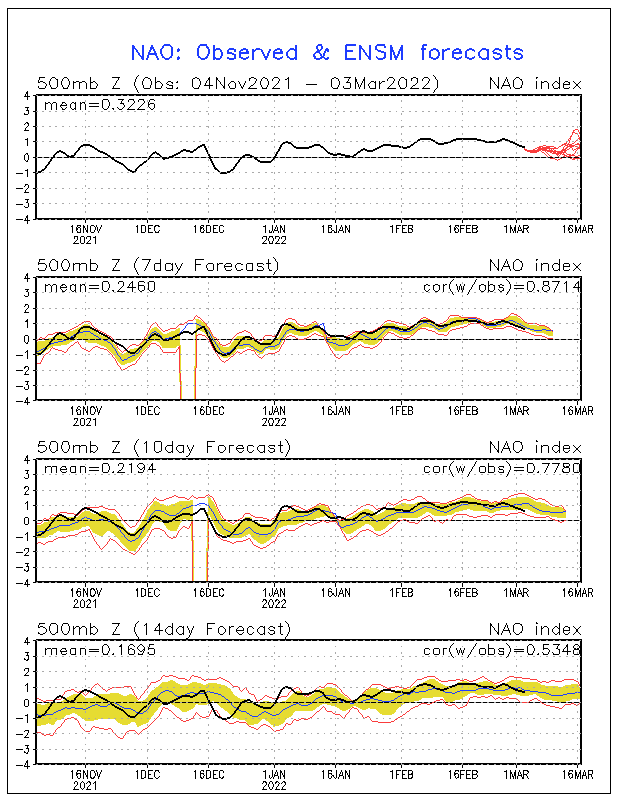
Therefore, since this winter's La Nina is east-based I believe that temperatures over most of the Northern United States will be below normal throughout most of the winter. But making a forecast just based on one variable won't do you any good. So I went ahead and did research on the NAO. As I have explained in past articles, the NAO stands for the North Atlantic Oscillation, which indicates that it has to do with the wind patterns across the North Atlantic. How the Climate Prediction Center determines the daily NAO is by taking the 500 millibar height difference between the Azores and Iceland and comparing it to normal. If the 500 millibar height difference is large compared to normal, the NAO is considered to be positive. During positive phases of the NAO, the storm tracks shifts northward, because there is such a large difference in air pressure, the jet stream is very strong, allowing for many storm systems to form over Iceland and make their way into northern Europe. Generally, winters and summers with a dominate positive NAO will cause much stormier than normal conditions over most Europe in both seasons. A negative NAO, indicates that the 500 millibar geopotential height difference is smaller than average and the difference can sometimes be negative in some extreme situations. This situation allows the jet stream to take a more southerly route across the United States and a southerly route toward Europe. In these situations, the jet stream is weaker across the Atlantic, and causes extended cold, dry periods across all of Europe, and across the United States, the weather tends to be much colder than normal, and it causes a very snowy, stormy weather pattern across the Eastern U.S. According to trends in recent months, and over the last several years, I expect the NAO to continue a downward trend and become more predominantly negative during the winter months, allowing for below normal temperatures and above normal snowfall throughout much of the east. Scientists have also studied another index that strongly correlates to the NAO. This index is the AO. The AO stands for the Arctic Oscillation, and refers to the wind patterns and temperatures in the stratosphere over the Arctic regions. When the AO is positive, this indicates that stratospheric temperatures over most of the arctic region are much below normal. Much below normal temperatures over the Arctic create strong westerly winds in the Arctic stratosphere due to the large temperature difference between the poles and the equator. With a positive AO, atmospheric blocking in lower layers of the atmosphere is reduced, allowing for an extremely amplified pattern with a strong jet stream over the Atlantic. When the AO is negative, stratospheric temperatures over the Arctic are much above normal, causing above normal heights and weak easterly winds. These weak easterly winds cause a ridge of high pressure to form in lower layers of the atmosphere. This ridge of high pressure generally located over Greenland, will cause a road block in the normal westward wind flow. The jet stream will move so that there is a major trough over the east, and when both the NAO and the AO are negative, this can create the potential for major storms across the East, especially during the winter season.

In actuality, I have read several articles about research being done on the NAO. They believe they have found a non-trending multi-decadal oscillation of the NAO. They have found that the NAO seems to have a thirty year cycle, going from mainly negative values to mainly positive values. They have found three such periods in the known record, extending back to the 1920's and 30's. From 1925 on to the 1950's, there was a positive period of the NAO, where only a few times was the NAO observed to have a negative value. During this same period in time, global temperatures increased. From the mid 1950's to the late 1970's, was an extended period of negative values of NAO, with only two months in the entire period having a positive value. During this time in earth's history, many of you probably remember the Great Ohio Blizzard '78 and the snowstorm in March of 1964, where Fort Wayne had their all-time greatest one day snowfall on record of 14.6 inches. During these years in earth's history, the average global temperature decreased and was actually about 0.8 degrees Celsius cooler than it was today. From the early 1980's onward to the late 1990's, the earth entered a very warm period, where temperatures the highest ever recorded in the 20th century, in 1998. In this same period of time, the NAO was in a predominantly positive phase, allowing for above normal warmth to spread farther northward. Currently we have entered a more stable phase of the NAO, where it has varied from year to year. In the last two years, scientists believe that we may have entered a negative phase of the NAO, as during the last two years the NAO has been predominantly negative.
The next variable I want to look at is the PNA. The PNA stands for Pacific North American pattern. Compared to the NAO and the AO, the PNA does not show any significant trends or cycles in the last one hundred years, and it is a very short term index. The PNA index refers to the height contour/pressure pattern from the Central Pacific coast to the Pacific Northwest and then towards the Eastern United States. If the PNA has a negative value, then there is generally a trough and stormy conditions hitting the West Coast, while the Southeast and East Coast enjoy mild conditions, while the Midwest is generally stormy. When the PNA has a positive value, a ridge is generally present over the West and a major trough is generally present over most of the East. Over the last several years, and especially during the past 10 months, the PNA has trended towards a positive value, indicating that this trend may continue into the winter months, but to a much lesser extent. This winter, I expect the NAO to remain negative more so than any of the other values I have been talking about. While I expect the NAO to continue to be negative, I do not expect it to be as extreme as last winter. This winter, the NAO will probably be slightly to moderately negative, indicating that the trough that will develop will be centered more so over the Midwest and Great Lakes, rather than the East Central states. The AO will more than likely average out to be only slightly negative, also indicating that the trough will be centered more so in the Midwest and Lower Great Lakes than in the East and Southeast. I expect the positive PNA values to be much less to an extreme, with values closer to zero. This should allow the trough to be centered more over the Midwest than last year.
I also used more indices in the development of my winter forecast, especially longer range values such as the PDO. PDO stands for Pacific Decadal Oscillation, which instead of dealing with pressure surfaces, it deals directly with sea surface temperature anomalies. Since it deals with temperatures, its value correlates much stronger with the Earth's weather than does the NAO, AO, and the PNA. According to research climatologists, they have found that the PDO has a distinct thirty year cycle, with which it varies from positive to negative. Even though the PDO has a thirty year cycle, it can vary from year to year especially in between significant ENSO events. During a negative PDO period, sea surface temperature anomalies are generally much below normal for the thirty year period for the oceanic region surrounding the Equatorial Pacific, while ocean regions of the Northwest Pacific experience much above normal temperatures. During a negative PDO period, east and central based La Nina's are more likely to form, especially stronger events, and as discussed above, east and central based La Nina's tend to bring cool temperatures to much of the Eastern United States during the winter months. Therefore, during the cool or negative phase of the PDO, much below normal temperatures are more likely across the east. During the warm phase of the PDO, warmer than normal temperatures exist near the equator in the Pacific, while cooler than normal waters exist across the Northern Pacific Ocean. This type of pattern allows El Nino frequency to increase, while La Nina events can happen and sometimes do happen, they are usually weak and west-based. Currently, we have just exited the last warm phase of the PDO in the late 1990's, and have entered a cooling phase of the PDO. As of 2011, PDO values are negative for the first time since the early 1980's. Over the last year, the PDO has really tanked, signally the start of the next cool phase in the Pacific. With this cool phase, expect frequent La Ninas, while United States winters get snowier and colder especially across the North. Also expect an increase in severe weather activity during the next thirty years, especially across the Ohio Valley. So what does the negative PDO mean for this winter? Well, I expect that a dropping PDO will cause a strengthening of the La Nina, and going with my forecast of a moderate to strong La Nina at that. Also, with the last negative PDO regime, (during the 60's and 70's), we saw some of the worst winters on record especially around here, where parts of the Corn Belt and Ohio Valley saw record cold and record snowfall. During the last year of the negative PDO, Fort Wayne had their snowiest winter on record, with 82.1 inches of snow falling during the winter season of 1981-1982. So this year, I would expect much above normal snowfall around here, with frequent bouts of arctic air into our area, as the jet stream will be positioned just to the south of our area.
Probably the most significant factor that affects weather here on earth, is the sun. It really does seem logical that the sun is most important factor in the Earth-Climate system. Currently, we are in a record low sunspot activity period that hit rock bottom in early 2009. According to Space Weather scientists, low sunspot activity indicates that incoming solar radiation is at an all time low, which by logic, low solar radiation indicates lower temperatures. Right now, we are in between Solar cycle 24 and Solar cycle 25, but according to some scientists, solar activity is so low that solar cycle 25 may not even occur, which would contribute to decreasing temperatures here on Earth. But you may asking, "then why was the past two summers so hot?" Nobody really can answer this, but it may be due to changes in the atmospheric circulation caused by the record low sunspot activity. Changes in the atmospheric circulation may also be linked to an increase in greenhouse gasses, or the cool phase of the PDO, but nobody really knows why we had the hot summers. Even though solar activity has been on the rise, according to the Space Weather Prediction Center, this solar cycle should peak in May of 2013, but in the short term, for this winter, solar activity should drop once more, before rising again in Spring 2012. Usually, low solar activity during the winter months indicates below normal temperatures across most of the Northern Hemisphere, excluding the arctic regions, where temperatures are usually above normal. A factor that may affect the cold temperature forecast, is the fact that solar activity has been increasing and may cause a stormier winter over North America than was originally forecast. One interesting fact that could mean a severe winter for a large part of the United States, is the fact that severe winters tend to repeat in a 34-37 year cycle. According to an article from Storm Central, this winter may be the winter that brings extreme weather to large parts of the Northern Hemisphere. According to many meteorologists' predictions, this winter may be the winter that sees extreme storm systems and extreme cold over the Northern and Eastern United States, while Europe will also see violent weather. This winter could even be the repeat of the winters of 1977-78 and 1978-79 over the United States. Here is the link to the article: Severe winter article
With all of these factors in play, this may be the winter to buy a snow blower or new shovel especially if you live in the Ohio Valley, Great Lakes, and Northern Plains, as an extreme winter is forecast with heavy snowfall and colder than normal temperatures. In my next post, I will give month by month forecasts for the entire United States, based on these trends and indices
The first major factor (and probably the most important of them all), is the fact that yet another La Nina is developing in the equatorial Pacific. Currently, the Climate Prediction Center has upgraded their La Nina Watch last month to a La Nina Advisory this month in their latest ENSO outlook. According to the latest analysis, the CPC (Climate Prediction Center) explains that the current La Nina is not near as strong as it was during September of 2010. This proves the fact that this year's La Nina will probably not be as strong as last year's. But over the last few weeks, La Nina conditions have been developing very quickly, with current La Nina conditions at about -1 degrees Celsius, which is way below September's ENSO index, which was only -0.6 degrees Celsius (note, when I refer to negative degrees celsius, I mean below normal and not as an actual temperature. Actual temperatures in the equatorial Pacific are about 18 degrees Celsius.). This value of the ENSO index indicates a border-line moderate La Nina. According to the latest underwater temperature anomalies, there is still a very large region of much below normal water temperatures upwelling to the surface from about 100-200 meters below the surface of the ocean. Most of these below normal water temperatures are occuring in the eastern and central regions of the Equatorial Pacific. I will explain the significance of this later in the discussion. Along with the factors that are promoting La Nina, I expect still declining SST anomalies, allowing for the strengthening of the La Nina. I would expect the La Nina to level sometime in late January 2012 or early February 2012, at a peak of about -1.4. In fact, this value may change because according to several of the NCEP's climate forecasting models, values may reach or exceed the ENSO index value of -1.5, with the CFSv2 forecasting a peak of about -2.0. A value of -2.0 would indicate one of the strongest La Nina's on record. But I really think the CFS's idea of this low of a value is almost farfetched, as current ENSO index levels are not nearly as strong as in 2010 at the same time, and we leveled off just before we could reach Strong La Nina values. So, in conclusion, I expect the peak of the La Nina to be at -1.4, which is the exact same as last year. Now back to talking about what east based and west based La Nina means. In a west-based La Nina, which hasn't happened in several years, the coolest and most concentrated cool waters are located over the western equatorial Pacific, is almost similar to what happens during an El Nino. Generally, west-based La Ninas cause a very strong ridge to form during the winter months over the East. This causes much above normal temperatures to extend back into the Plains states, who would normally bring significantly cool temperatures to the plains. During west-based La Nina winters, the Ohio Valley and Great Lakes would see plenty of precipitation, but not much in the way of snow. They also tend to reduce Lake effect snowfall amounts. During east-based La Ninas, widespread below normal temperatures occur over much of the U.S., excluding the Southeast and Florida. Precipitation is also above normal from the Great Lakes and Ohio Valley on toward the East Coast. Here are some maps to illustrate what I just explained.
 z
zTherefore, since this winter's La Nina is east-based I believe that temperatures over most of the Northern United States will be below normal throughout most of the winter. But making a forecast just based on one variable won't do you any good. So I went ahead and did research on the NAO. As I have explained in past articles, the NAO stands for the North Atlantic Oscillation, which indicates that it has to do with the wind patterns across the North Atlantic. How the Climate Prediction Center determines the daily NAO is by taking the 500 millibar height difference between the Azores and Iceland and comparing it to normal. If the 500 millibar height difference is large compared to normal, the NAO is considered to be positive. During positive phases of the NAO, the storm tracks shifts northward, because there is such a large difference in air pressure, the jet stream is very strong, allowing for many storm systems to form over Iceland and make their way into northern Europe. Generally, winters and summers with a dominate positive NAO will cause much stormier than normal conditions over most Europe in both seasons. A negative NAO, indicates that the 500 millibar geopotential height difference is smaller than average and the difference can sometimes be negative in some extreme situations. This situation allows the jet stream to take a more southerly route across the United States and a southerly route toward Europe. In these situations, the jet stream is weaker across the Atlantic, and causes extended cold, dry periods across all of Europe, and across the United States, the weather tends to be much colder than normal, and it causes a very snowy, stormy weather pattern across the Eastern U.S. According to trends in recent months, and over the last several years, I expect the NAO to continue a downward trend and become more predominantly negative during the winter months, allowing for below normal temperatures and above normal snowfall throughout much of the east. Scientists have also studied another index that strongly correlates to the NAO. This index is the AO. The AO stands for the Arctic Oscillation, and refers to the wind patterns and temperatures in the stratosphere over the Arctic regions. When the AO is positive, this indicates that stratospheric temperatures over most of the arctic region are much below normal. Much below normal temperatures over the Arctic create strong westerly winds in the Arctic stratosphere due to the large temperature difference between the poles and the equator. With a positive AO, atmospheric blocking in lower layers of the atmosphere is reduced, allowing for an extremely amplified pattern with a strong jet stream over the Atlantic. When the AO is negative, stratospheric temperatures over the Arctic are much above normal, causing above normal heights and weak easterly winds. These weak easterly winds cause a ridge of high pressure to form in lower layers of the atmosphere. This ridge of high pressure generally located over Greenland, will cause a road block in the normal westward wind flow. The jet stream will move so that there is a major trough over the east, and when both the NAO and the AO are negative, this can create the potential for major storms across the East, especially during the winter season.
In actuality, I have read several articles about research being done on the NAO. They believe they have found a non-trending multi-decadal oscillation of the NAO. They have found that the NAO seems to have a thirty year cycle, going from mainly negative values to mainly positive values. They have found three such periods in the known record, extending back to the 1920's and 30's. From 1925 on to the 1950's, there was a positive period of the NAO, where only a few times was the NAO observed to have a negative value. During this same period in time, global temperatures increased. From the mid 1950's to the late 1970's, was an extended period of negative values of NAO, with only two months in the entire period having a positive value. During this time in earth's history, many of you probably remember the Great Ohio Blizzard '78 and the snowstorm in March of 1964, where Fort Wayne had their all-time greatest one day snowfall on record of 14.6 inches. During these years in earth's history, the average global temperature decreased and was actually about 0.8 degrees Celsius cooler than it was today. From the early 1980's onward to the late 1990's, the earth entered a very warm period, where temperatures the highest ever recorded in the 20th century, in 1998. In this same period of time, the NAO was in a predominantly positive phase, allowing for above normal warmth to spread farther northward. Currently we have entered a more stable phase of the NAO, where it has varied from year to year. In the last two years, scientists believe that we may have entered a negative phase of the NAO, as during the last two years the NAO has been predominantly negative.
The next variable I want to look at is the PNA. The PNA stands for Pacific North American pattern. Compared to the NAO and the AO, the PNA does not show any significant trends or cycles in the last one hundred years, and it is a very short term index. The PNA index refers to the height contour/pressure pattern from the Central Pacific coast to the Pacific Northwest and then towards the Eastern United States. If the PNA has a negative value, then there is generally a trough and stormy conditions hitting the West Coast, while the Southeast and East Coast enjoy mild conditions, while the Midwest is generally stormy. When the PNA has a positive value, a ridge is generally present over the West and a major trough is generally present over most of the East. Over the last several years, and especially during the past 10 months, the PNA has trended towards a positive value, indicating that this trend may continue into the winter months, but to a much lesser extent. This winter, I expect the NAO to remain negative more so than any of the other values I have been talking about. While I expect the NAO to continue to be negative, I do not expect it to be as extreme as last winter. This winter, the NAO will probably be slightly to moderately negative, indicating that the trough that will develop will be centered more so over the Midwest and Great Lakes, rather than the East Central states. The AO will more than likely average out to be only slightly negative, also indicating that the trough will be centered more so in the Midwest and Lower Great Lakes than in the East and Southeast. I expect the positive PNA values to be much less to an extreme, with values closer to zero. This should allow the trough to be centered more over the Midwest than last year.
I also used more indices in the development of my winter forecast, especially longer range values such as the PDO. PDO stands for Pacific Decadal Oscillation, which instead of dealing with pressure surfaces, it deals directly with sea surface temperature anomalies. Since it deals with temperatures, its value correlates much stronger with the Earth's weather than does the NAO, AO, and the PNA. According to research climatologists, they have found that the PDO has a distinct thirty year cycle, with which it varies from positive to negative. Even though the PDO has a thirty year cycle, it can vary from year to year especially in between significant ENSO events. During a negative PDO period, sea surface temperature anomalies are generally much below normal for the thirty year period for the oceanic region surrounding the Equatorial Pacific, while ocean regions of the Northwest Pacific experience much above normal temperatures. During a negative PDO period, east and central based La Nina's are more likely to form, especially stronger events, and as discussed above, east and central based La Nina's tend to bring cool temperatures to much of the Eastern United States during the winter months. Therefore, during the cool or negative phase of the PDO, much below normal temperatures are more likely across the east. During the warm phase of the PDO, warmer than normal temperatures exist near the equator in the Pacific, while cooler than normal waters exist across the Northern Pacific Ocean. This type of pattern allows El Nino frequency to increase, while La Nina events can happen and sometimes do happen, they are usually weak and west-based. Currently, we have just exited the last warm phase of the PDO in the late 1990's, and have entered a cooling phase of the PDO. As of 2011, PDO values are negative for the first time since the early 1980's. Over the last year, the PDO has really tanked, signally the start of the next cool phase in the Pacific. With this cool phase, expect frequent La Ninas, while United States winters get snowier and colder especially across the North. Also expect an increase in severe weather activity during the next thirty years, especially across the Ohio Valley. So what does the negative PDO mean for this winter? Well, I expect that a dropping PDO will cause a strengthening of the La Nina, and going with my forecast of a moderate to strong La Nina at that. Also, with the last negative PDO regime, (during the 60's and 70's), we saw some of the worst winters on record especially around here, where parts of the Corn Belt and Ohio Valley saw record cold and record snowfall. During the last year of the negative PDO, Fort Wayne had their snowiest winter on record, with 82.1 inches of snow falling during the winter season of 1981-1982. So this year, I would expect much above normal snowfall around here, with frequent bouts of arctic air into our area, as the jet stream will be positioned just to the south of our area.
 |
| Decadal averages of PDO values |
 |
| Solar sunspot activity |
With all of these factors in play, this may be the winter to buy a snow blower or new shovel especially if you live in the Ohio Valley, Great Lakes, and Northern Plains, as an extreme winter is forecast with heavy snowfall and colder than normal temperatures. In my next post, I will give month by month forecasts for the entire United States, based on these trends and indices

No comments:
Post a Comment